


10.21.26
Ep. 15 Kids Savings Accounts in West Michigan | Money Playbook
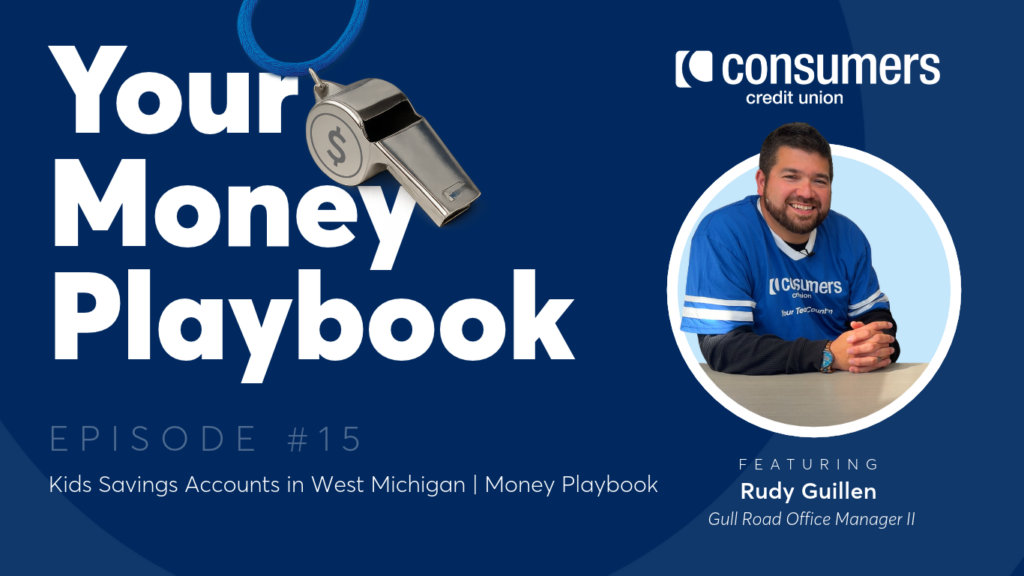
Saving for a child’s future starts with understanding your options. In this episode, we break down the differences between Certificates of Deposit (CDs), 529 college savings plans, and youth savings accounts, helping parents choose the right option for their financial goals. Learn how fixed interest rates, compound growth, and low-risk savings strategies can help build an education fund over time. We also explore practical ways to teach kids about budgeting, saving money, earning allowances, and setting long-term financial goals.
[music]
0:00:05.5 Lynne Jarman-Johnson: It’s Your Money Playbook. Hi, I’m Lynne Jarman-Johnson with Consumers Credit Union and Coach Rudy is here. We’ve got a great caller with a great question. John, let’s hear what you’re asking about today.
0:00:16.9 John: Hey there. My name is John and I’m a young dad with a daughter in kindergarten at Mattawan. I’m starting to think seriously about saving for college. I recently received $5,000 from a grandparent who passed away and want to put it somewhere safe that can earn interest without risking loss. I’m trying to figure out what youth savings or education accounts make the most sense, whether I could stay the owner while setting it aside for her or what other options might be available. Thank you.
0:00:38.5 LJJ: Well, thank you so much for that call, John. We’ve got Coach Scott who’s going to help us kick it off with safe ways to grow money.
0:00:45.5 Coach Scott: Want a safe, predictable way to grow your savings without the ups and downs of the stock market? A certificate of deposit, or CD, could be a smart option. A CD is a savings account with a twist. You lock in your money for a set time and earn a fixed interest rate in return. Terms vary: six months, one year, even five years. For example, you might put $1,000 in a one-year CD at 3.5%. That would earn you $35 in interest at the end of the year. Better than most savings accounts, right? But there’s a catch. You can’t touch the money until the term ends. If you do, you’ll likely have to pay a penalty. So, that $1,000 with a one-year term, that’s there to stay the whole year. CDs are great if you want low risk and predictable growth. They’re not flashy, but they’re reliable. Want to learn more? Let us know. Consumers, we’re your team to count on.
0:01:40.0 LJJ: Thank you, Coach Scott. We also have Coach Rudy. So, John mentioned savings and really wanting to make sure that it’s risk-free for his daughter. Is there a program that he should be looking into? What does Consumers have?
0:01:53.9 Coach Rudy: Yeah, we have a perfect product for that, a certificate of deposit. We call it a CD for short here in the office. It’s a product where we’ll make a deposit into that product, keep it for … It could be a year, it could be five years. No risk to him. It’s not going into the market. It’ll earn a set interest rate for that period of time that we put it in there. At the end of that period, so say it’s a year for our new Yearly Stride CD that we have for the youth, he’ll come back in at the end of that year, he can add some additional funds to it.
0:02:22.9 LJJ: And it just keeps going.
0:02:23.2 CR: And it just keeps going. It’ll keep getting the interest rate. You’ll see it compound monthly on his bank statement or in his online app, and no risk to him. And he’ll just see the money grow, and then he can add to it at the end of each year.
0:02:33.0 LJJ: And I’m really glad you said certificate of deposit, because truly that is what a CD is. And sometimes you see it out there, and I’ve had someone say to me, “Well, I can’t do a CD.” They think it’s like some thing. And I’m like, “Oh no, it’s a savings account, a very special one.”
0:02:50.3 CR: The one key thing to differentiate a CD from a savings account is that once we put it in there, it’s locked in for that term. So, if it’s 12 months, then that money’s got to stay in there for that 12 months. If for some reason they have to try to get that money out early, they will pay a penalty on that. So we want to be mindful that it’s not like a standard savings account. So once the money’s in, it’s locked in for that period of time, and then at the end of that period, you can draw the money if you’d like or re-add to the money.
0:03:14.3 LJJ: And I think it’s important that some people really look at and ask the questions of what does this CD look like? So, our Yearly Stride CD is literally for young children, and as they grow, it compounds and continues to go versus closing and starting and closing and starting a CD. So what is the difference between a savings account and a CD?
0:03:36.6 CR: The big difference for the savings account, I guess when it comes to rate, would be this: is that you’re locked in at that set rate. So if you come and open the CD with me today and I give you the 1.5 interest rate, you’re going to get, for example, you’d get that rate for the whole 12 months or five years or however long you lock that CD in.
0:03:53.2 LJJ: And normally a CD has a higher interest rate than a regular than a regular savings account.
0:03:58.4 CR: Than a standard savings account. Correct.
0:03:58.9 LJJ: And obviously there’s savings programs that are through the state, through the government, that you also can look into. I like the fact that there’s personal attention.
0:04:08.5 CR: Yeah, we can give him the attention, talk to him about different products and let him see what would work best for him. Whether it would be a 529 plan, whether it would be a long-term CD, and just see how he’s looking at it and if he’s looking at adding to it. So with the CD, it wouldn’t be adding to the CD at the end of that term. With the 529 plan, he can make a monthly deposit into that program for his daughter and then that money’s just growing for him.
0:04:31.1 LJJ: Can you explain what is a 529 for those that don’t know what that is?
0:04:35.3 CR: Yeah. The 529 College Savings Plan is money to use when your kid’s ready to go to school. Now recently we’ve just changed that. It doesn’t have to be a four-year college school, it can be a vocational school, a trade school. So with the need in those markets, even better. So now it’s the flexibility to be able to use it anywhere.
0:04:53.6 LJJ: You’re also a dad. So tell us a little bit about your family and how you started on the savings road.
0:04:59.8 CR: Yeah, I have a seven-year-old son and teaching him about financial goals was always a goal of mine. So we did our Wimee savings just because I knew he was going to get a bank account, was going to get the plushie and a book, and I knew those things were going to motivate him to kind of come in and make deposits. And then when he gets money from his birthday, like from grandparents, bring it into the credit union, make the deposit and then see what potential gift he get next and just kind of see the balance he keeps in his account.
0:05:25.6 LJJ: So you’re talking about our Wimee Savings Club, which is so fun because Wimee, who is our robot here, really does help bring little kids that whole thought process of spending, saving, gifting. How is it that you’re talking with your son about this?
0:05:43.7 CR: We just have conversations when he gets the money, what to do with it. So like if he gets money, like I said, from a birthday party, a gift from a grandparent or he’s just saving from an allowance because we just started doing the whole allowance thing. Let’s do some chores, Dad will pay an allowance at the end of the week, which has gotten a little more expensive since I was a kid, but it’s a good goal to get.
0:06:03.0 LJJ: Okay, all right, let me hear it. What’s the amount?
0:06:06.0 CR: Well, I’m doing $20 a week.
0:06:07.5 LJJ: Oh, that’s a good amount.
0:06:08.8 CR: Which I think’s a lot. I don’t think I was getting 20 a week back in the day.
0:06:12.2 LJJ: I’m not getting $20 a week.
0:06:14.2 CR: But I’m having him do some chores that are a little bit different. I mean, for example, just the other day took the truck for a car wash and then I’m like, “You vacuum the truck out. $25,” So I sat there, showed him how to use the vacuum and he cleaned out the truck, which actually brought him some excitement was kind of … Almost felt bad a little bit, but I also got some enjoyment just seeing him pay attention to the details of it. And then we got done, I rewarded him. Hey, you did a job, you get paid for doing the job.
0:06:40.5 LJJ: You know, our accounts are set up so he has his own Wimee savings account. And then can you easily transfer money and see what’s going on in that account?
0:06:50.0 CR: Yeah, from my online banking app, I can move money from my checking or my savings account into his account. I can see his balance. I sometimes show him the balance that he has in his account. But ultimately we do have an end goal. With this savings account, we’re trying to grow so much money into it each year so that way when he turns 18, he’d have the ability to hopefully purchase a vehicle on his own. Just kind of getting an end goal just to work towards something so he can achieve it and then he can keep the money in there and know, “Hey, I can’t spend it on the new PS5. I have to try to save.” I got a long-term goal here, teaching him that long-term.
0:07:23.5 LJJ: How easy is it to set up a Wimee savings account?
0:07:26.5 CR: Walk into any one of our Consumers offices and one of our great team members or coaches will help you. Quick and easy.
0:07:32.5 LJJ: So when you’re looking at a seven-year-old, okay, the thing that I am hearing from you is it’s hands-on teaching, right? It’s not set it and forget it. It’s showing every time so that you can say, “Look at what’s happening.”
0:07:46.5 CR: Yep. And every time we have a goal, like I said, he gets over $100 in his wallet, then we talk about what we’re doing with the $100. We’re going to keep half of it and keep it in the wallet and then we’re going to take the other 50 and walk into Consumers and make a deposit.
0:07:58.9 LJJ: You know, as the kids get older, how important is it to help them understand the different buckets of saving? It’s not just about saving. I know with our program, Roundup for Impact, we focus on giving too. And are you doing that in your home and how easy is that for a seven-year-old to understand?
0:08:19.1 CR: I think that it’s easy to understand if we’re having the right conversation with our kids. And so we talk about, we talk about the Roundup for Impact in my house because we talk about donations if we’re going to the store, donations if we’re helping somebody we see on the street or out at the store. But I think showing them that we budget this way. So if we’re going to have this savings account for this goal, this savings account for that goal, or this other account for an incidental goal, that we don’t dip into the other bucket unless it’s an emergency. Unless there’s like a catastrophic situation that unfortunately does happen with families, that we have to dip in that bucket. But we try to make sure we can manage those. And I think the sooner we can teach that financial education to our kids, the better position we are positioning them as adults.
0:09:01.9 LJJ: It sounds like transparency is so important. That open conversation with children because, I’ll tell you what, that’s where you’re going to learn. And all of a sudden you get to college and it’s too late. Right?
0:09:16.0 CR: Yeah, because then you don’t have it figured out. You’re getting your first credit card, you don’t have a savings account. So something comes up and you’re at school, you can’t get a hold of your parents and you need some money because maybe you have a car and you get a flat tire and you don’t know how to figure that out, then you’re in a bad situation. So if we’re teaching our kids now how to utilize those tools and what those tools mean, they’ll know what the impact is to them as they get older.
0:09:37.6 LJJ: Is it hard to help, especially today? I mean, right now things seem to be so expensive. You know, gas today, I filled my car up and I just, you know, it’s sticker shock. Is it hard or is it easy for you? Are you helping him understand the value of money? So let’s say it’s grocery shopping time. We used to sit around the table and we would have the kids guess, guess what this meal cost today. And I was so surprised when we started it at what their thought process was.
0:10:13.0 CR: Yeah, it’s funny you said that because we just talked about it when Dad had to go fill up his pickup truck the other day. And he had asked me how much it costs. And I talked to him and he happened to have his wallet in the back seat of the car. I go, so open the wallet. You know how much money’s in there? I need you to take out $90 out of your wallet, set it off to the side and that’s what it costs to put in Dad’s pickup truck. And then that’s the money now you have left in the wallet. And he goes, well, yeah, so you think about it, if we’re traveling up north to go see grandma and grandpa or taking a trip to Dave and Buster’s in Grand Rapids, this is how much gas …
0:10:44.3 LJJ: That’s a great fun time.
0:10:44.6 CR: Yes, it is a fun time.
0:10:45.6 LJJ: That’s expensive.
0:10:46.3 CR: But you have to think about how much money’s coming out of the wallet each time. And it takes just as long if not longer to put it back in. So you have to pay attention to that. So even when we go to the store, he wants to buy a toy, got the wallet, pull the wallet out, this is what it’s going to cost you. Do you want that toy? And then I’ve seen it nine times out of ten in the past couple months, the money goes back in the wallet and he goes, I’ll think on it. And we don’t buy it. And I think that helps because then it’s keeping more money in his wallet. And then when he hits that again, he hits that benchmark of the $100 and we’re putting it half in the savings, keeping the half in the wallet and so we’re spending less. But he’s seeing it now and I think at seven years old, about to turn eight, I think that impact is going to pay off.
0:11:25.1 LJJ: What amazing learnings that he’s having. And it’s day to day. That is awesome, Rudy. Coach Rudy, this has been awesome. What a great topic. Savings, starting early. It’s now time for your Money Playbook and your top three tips.
0:11:39.6 CR: All right, tip number one, educate. Tip number two, budget. And tip number three is consistently have the conversation.
0:11:47.4 LJJ: With kids at any age.
0:11:48.7 CR: At any age.
0:11:49.9 LJJ: And I’m going to put in a tip. How about making sure that you start your Kids Club here at Consumers Credit Union with Wimee. John, thank you so much for calling. This was a great topic. We sure loved it. And if you have a topic that you’d like for your Money Playbook, give us a call. 269-213-3360. It’s your Money Playbook at Consumers Credit Union.
[music]