


6.19.26
Ep. 6: HELOC Pros and Cons Explained | Winning Formation | Money Playbook
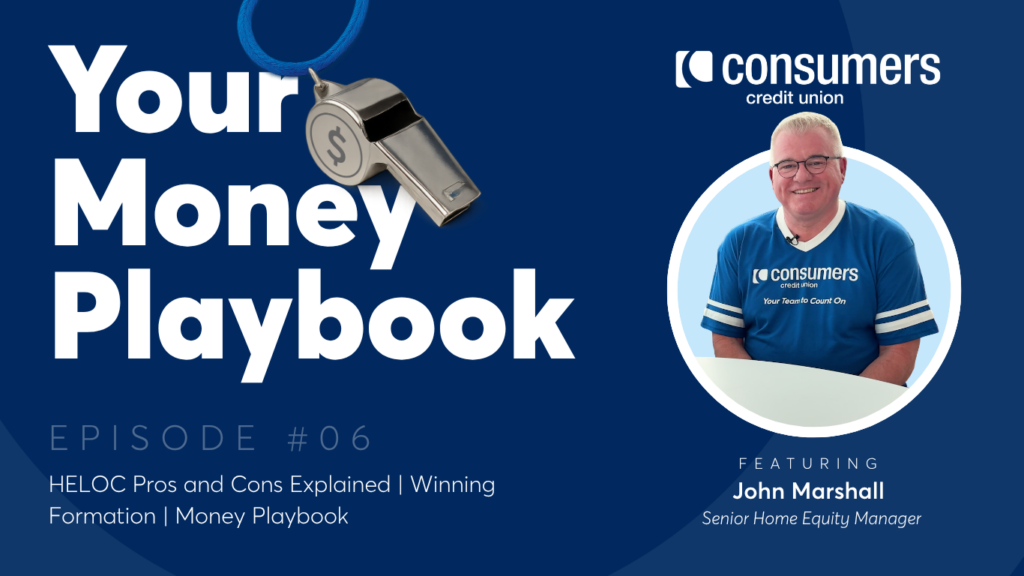
This episode of Your Money Playbook puts the spotlight on Home Equity Lines of Credit. We’ve got the perfect coach in Senior Home Equity Manager John Marshall, who breaks down how to use a HELOC wisely. He discusses when it makes sense to open one and even shares a powerful story about a member who used theirs in a way you wouldn’t expect.
0:00:04.8 Lynne Jarman-Johnson: Welcome in, to Your Money Playbook. I’m Lynne Jarman-Johnson and we have Coach John with us today who is going to dig in deep on a topic that we got a phone call from. Let’s listen in to Jim.
0:00:16.6 Jim [CALLER]: Hey, my name is Jim. I’ve been living in my house for a few years now and just got the kids off to college. Finally got some time to really focus on my house and really want to get my kitchen updated. Here’s the thing now, with paying their tuition, I don’t really know if I can afford it. Buddy of mine, he mentioned something called a HELOC, but honestly, I have no idea where to start or even if it’s a good idea for me. I was wondering if you could call me back and walk me through what that looks like and even if it makes sense. Appreciate it.
0:00:41.3 LJJ: I’ll tell you what, Jim. That question on what is a HELOC? HELOCs are … I don’t even know, it stands for something. We’re going to find that out. Coach Tim is going to give us a breakdown.
0:00:51.9 Coach Tim: So you want to tackle a loan, but you’re not sure about the best kind. A home equity line of credit, or HELOC, might be a good choice for you. It’s like a credit card, but it’s backed by the equity in your house. You can use it for home improvements, emergencies or even college tuition. And you only pay interest on what you draw. Nice, right? Rates and payments can be flexible and you might even score some tax perks. But hold up, there may be some flags on this play, too. HELOCs usually have variable interest rates. That means your payment could go up. And remember, your house is the collateral. If you can’t pay back your HELOC, you could lose your home. Plus, if you use up too much equity, you might be stuck in your home longer than you had planned. And don’t treat your HELOC like free money. That kitchen remodel? Good call. A Jet Ski? Maybe not. So is a HELOC right for you? It can be just the clutch play you need, but only if you use it wisely. Want to learn more? Let us know. Consumers, we’re your team to count on.
0:01:56.4 LJJ: Well, thank you, Coach Tim. John, I’ll tell you what, you have a wonderful team that helps all of our members get a HELOC. All right. Home equity line of credit.
0:02:10.9 Coach John Marshall: Correct.
0:02:11.4 LJJ: How many times a day do you get, “What’s a HELOC?”
0:02:13.0 Coach JM: We get asked that question often. In the simplest terms, a HELOC is a type of loan that allows you to use the equity in your home as collateral to fund the loan.
0:02:25.5 LJJ: Let’s just do an example of a scenario. I have a $300,000 house, all right? And I come to you and I say, “Hey, I’d like this loan.” What is it that you do and then how much do you think I could get?
0:02:39.1 Coach JM: Sure. So if your home is worth $300,000, we will take a look at how much you might currently owe on the house. If your first mortgage is at $100,000, there’s $200,000 of equity in your home.
0:02:56.0 LJJ: That you could possibly use.
0:02:57.7 Coach JM: You could possibly use it. We don’t typically go all the way up to that 200,000, but best rates hover around 80% of that number or less.
0:03:08.2 LJJ: So I think what some people might get confused about with a line of credit comparatively to a standard loan. Explain the differences, John, and why a line of credit can be so much more flexible.
0:03:20.9 Coach JM: Sure. With a standard loan, if you borrow a certain dollar amount, let’s say $50,000, you are given $50,000 and you start paying back $50,000 plus interest. With a HELOC, it’s a line of credit. So $50,000 might be available to you, but if you only need 20,000 of it to remodel a kitchen, for example, you’re only being charged interest on that 20,000.
0:03:49.1 LJJ: Not the 50.
0:03:50.4 Coach JM: Not the 50. And you’re only required to pay back that 20,000.
0:03:53.7 LJJ: And this is something that you can actually do back and forth. The 20,000 doesn’t just then all of a sudden sit there and become a loan. This is still a line of credit.
0:04:04.2 Coach JM: Correct. Much like a credit card, it’s on your line of credit’s balance and you can pay it back as you need to or as you’re able to. And you can draw more from the line if you need to, so you don’t have to pay that $20,000 back before you can access the line again.
0:04:21.2 LJJ: How is it that we help people decide what and how to use a HELOC?
0:04:25.5 Coach JM: So you wouldn’t want to use a HELOC to just finance your everyday lifestyle. It is designed for some of those bigger transactions that we mentioned. Most of the time, a home equity … A HELOC is used for some of those expenses that are hard to meet but important to your future.
0:04:44.9 LJJ: Tell me a little bit about how, when you are trying to get a HELOC, do I have to have my mortgage with Consumers to get a HELOC through Consumers?
0:04:54.3 Coach JM: You do not. Nope. You can have your mortgage at another institution. Maybe you don’t have a mortgage at all. A HELOC is considered a second mortgage. So just like the first, your home is collateral, but it doesn’t matter where you have your first one.
0:05:06.9 LJJ: Do you have to have current appraisals like you do through a mortgage where you’re going through the whole system again or?
0:05:14.6 Coach JM: There’s a number of ways we can value your home. We will start off with what’s called an AVM, an automated valuation model. If that meets your needs, no further appraisal required. There are circumstances where an appraisal might be needed, depending on how much you currently owe on your house, the loan amount you’re requesting, but quite often we can do it without an appraisal at all.
0:05:37.0 LJJ: Jim had mentioned in his call about the fact that he was worried about being able to pay it back. Is that some of the coaching that is done to say, “Here’s what your payments are going to be and let’s be realistic with your budget”?
0:05:48.9 Coach JM: Definitely. We will look at what we call your debt-to-income ratio and basically it’s what you can afford as a payment on the loan. We’ll run through some scenarios with you. One of the interesting features of a HELOC is the payment can be interest only for the first … It’s called the draw period, when you can take money from it. So that can help keep your payments down for that period of time while you get your budget in order and your immediate needs handled.
0:06:16.1 LJJ: And once you have a HELOC, can you easily pay it back as you go or do most people just go on that monthly budget plan?
0:06:24.0 Coach JM: The way a HELOC works, it has an initial period called a draw period where you can borrow money from it, pay it back, borrow money from it again, pay it back again, over and over and over for that first 10 years. If you have a balance at the end of that 10 years, then it becomes a principal and interest payment.
0:06:42.3 LJJ: That’s a loan that is … Yeah, it’s set in stone and here’s the number.
0:06:46.1 Coach JM: The basic traditional loan, yeah.
0:06:47.7 LJJ: Okay. 10 years is a long time.
0:06:49.2 Coach JM: For sure, definitely.
0:06:50.6 LJJ: Have you found that people like that time period and is that different than other institutions or is it pretty much across the board?
0:06:57.1 Coach JM: 10 … It’s usually 7 to 10 years is a pretty standard time period. What it gives you though is just flexibility, not only for your immediate financial needs, but for those unexpected ones that might come in the future. So that longer draw period does hold some appeal.
0:07:12.3 LJJ: It’s really funny, I think people think, oh, they’ve got their mortgage and then honestly, don’t you forget that here is this beautiful asset that you have that can really help you?
0:07:24.4 Coach JM: You’ve all probably heard before that your house can be one of your biggest investments. Your mortgage helps you buy that house. This HELOC helps you make that house work for you like any investment would.
0:07:38.6 LJJ: What’s your favorite HELOC story? Do you have one where it just comes to mind or maybe a member that you just know you’ve helped and it just makes you smile?
0:07:47.3 Coach JM: Yes. Several years ago, I had a member want a HELOC to adopt a child and it helped her pay all the costs associated with that, not only in the adoption itself, but just bringing him into her house and into her life. And it’s very touching, very memorable.
0:08:07.2 LJJ: And John, that’s the whole point right there. Oh my gosh, creating new memories and making them, and with the help of your home.
0:08:15.5 Coach JM: Exactly, right.
0:08:16.6 LJJ: Right? Oh my gosh. Okay. Couple things quickly just to make sure that we’ve got everybody on board. What exactly do we need to do? What paperwork do we need when it’s time to say, “Hey, I’m interested in opening up a HELOC”?
0:08:32.6 Coach JM: Any one of our loan officers can send you a link to start your application. As you complete that application, there’ll be a few requirements: pay stubs typically, copy of your driver’s license, tax returns we do a lot of self-employed borrowers and so we’ll need tax returns. And then the other things can vary depending on your circumstances, but we’ll talk through all of that with you.
0:08:54.2 LJJ: And it’s very simple. And the one thing I can tell you about any one of our Consumers Credit Union coaches, we’re there to help all the time.
0:09:03.1 Coach JM: Absolutely.
0:09:04.0 LJJ: Absolutely. That is the whole point, to get you across that finish line. Coach John Marshall, my goodness, what a great conversation we had. It is a lot to unpack. Let’s get your top three tips for anybody listening and who’s interested in a home equity line of credit.
0:09:18.4 Coach JM: Sure. I would say number one, be realistic about what you can afford. Number two, gather up some of your pay stubs and other paperwork that you might have before you start the application, because it will be asked. And number three, ask questions. There’s a lot to these and they might be new to you, so don’t hesitate. We’re here to help.
0:09:38.8 LJJ: Thank you so much, Coach John. We’d like to thank Coach Tim and also our caller, Jim, for asking some great questions about HELOCs. If you have a topic that you’d like, feel free to give us a call. The number is 269-213-3360. And guess what? We are your Money Playbook.